Quality Control
AQL Inspection Explained: What Actually Passes or Fails a Sportswear Order
AQL 2.5, 4.0 and 0 explained for sportswear buyers: sample sizes, pass/fail math on a 1,000-unit order, common garment defects and when to inspect.
Quick answer
AQL (Acceptable Quality Level) is the international sampling standard — ISO 2859-1 — that defines how many defective units are allowed in a random sample before an entire production batch fails inspection. Most sportswear orders are inspected against AQL 2.5 for major defects (functional problems like open seams or misaligned prints) and AQL 4.0 for minor defects (cosmetic issues that don't affect wearability), with AQL 0 — zero tolerance — for critical defects like safety hazards.
Concretely: on a 1,000-unit order inspected at AQL 2.5, an inspector randomly checks 80 units, and the whole batch fails if 6 or more of those 80 have a major defect. Specify your AQL requirement in the purchase order before production starts — it's difficult and often costly to change once the factory has begun.
This article is part of our apparel quality control guide, written for brand founders, importers and team buyers ordering custom sportswear, team uniforms and private label activewear from an overseas manufacturer.
What AQL actually measures, and why the math matters
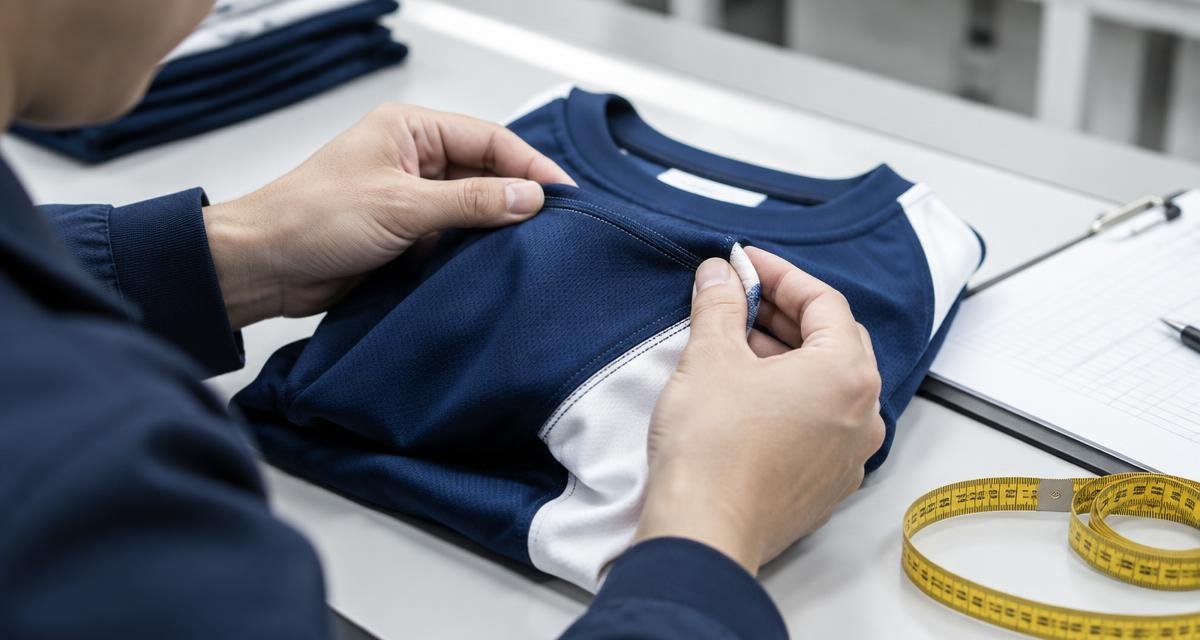
AQL isn't a vague quality promise — it's a statistical sampling rule. Instead of inspecting every single unit in an order (expensive and slow at scale), an inspector checks a randomly selected sample sized according to the total order quantity, and the number of allowable defects in that sample is fixed in advance by the AQL level agreed upon. This turns "good quality" from a subjective argument after the fact into a documented, numeric pass/fail decision agreed before production even begins.
| AQL level | Defect severity | What it covers | Sportswear example |
|---|---|---|---|
| AQL 0 | Critical | Safety hazards or compliance failures — zero tolerance | A needle left in a seam, a missing or wrong care label |
| AQL 2.5 | Major | Functional failures that would cause a return | Skipped or broken stitches, open seams, wrong sizing, misaligned sublimation print |
| AQL 4.0 | Minor | Cosmetic issues that don't affect function | Uncut threads over half a centimetre, slight shading in a non-visible panel |
A worked example: 1,000 jerseys at AQL 2.5
The abstract definition rarely sticks on its own, so here is the math. For a 1,000-unit order inspected at AQL 2.5 for major defects, the inspector randomly samples 80 units. The acceptance number is 5 and the rejection number is 6:
- 0–5 major defects found in the 80 sampled units → the batch passes
- 6 or more major defects found → the entire 1,000-unit batch fails, not just the sampled 80
Premium retailers and brands with lower risk tolerance sometimes specify a stricter AQL 1.5 for major defects instead of the standard 2.5, which lowers the number of allowable defects in the same sample size.
| Order quantity (example) | Typical sample size (General Inspection Level II) | AQL 2.5 major — fail at | AQL 4.0 minor — fail at |
|---|---|---|---|
| 1,000 units | 80 | 6 or more | 8 or more |
Sample sizes and acceptance numbers come from the ISO 2859-1 tables and scale with lot size; ask your inspector or manufacturer to quote the exact figures for your order quantity in writing.
The sportswear-specific defects that actually show up in inspections
Generic apparel defect lists miss the failure points specific to technical sportswear. The ones that come up most often in practice:
- Misaligned or bleeding sublimation prints — a real risk on all-over printed jerseys; see our sublimation vs screen printing guide for why this trade-off exists in the first place
- Skipped or broken stitches at stress points — armholes, side seams, and anywhere a garment is expected to stretch repeatedly during use
- Seam puckering or uneven tension, especially on technical knits that behave differently under the needle than woven cotton
- Colourfastness and dye migration between panels — a specific risk on team jerseys with contrasting colour blocks, where one colour can bleed into an adjacent lighter panel during washing or production
- Inconsistent stretch recovery in performance fabric — invisible on the rack and only apparent once the garment is worn, which is why fabric testing before bulk production matters as much as visual inspection after (see our polyester vs cotton fabric guide and fabric GSM guide for activewear)
- Sizing inconsistency across a production run — the same size label measuring differently across units in the same batch, a particular risk on large custom team jersey orders where dozens of identical units must match
When inspections should actually happen
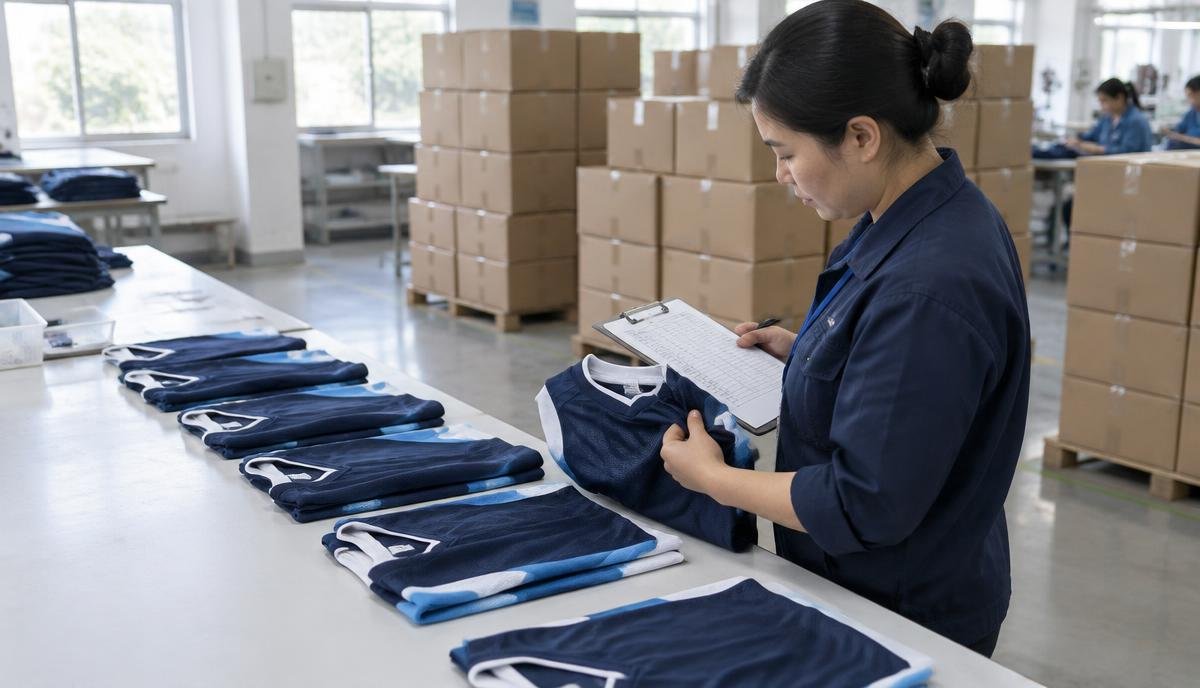
Waiting until goods are packed and ready to ship is the most common — and most expensive — mistake. Structured garment inspection happens at three points:
| Stage | When | What gets checked | Why it matters |
|---|---|---|---|
| Pre-production | Before cutting | Fabric, GSM, colour, trims, approved sample | Stops a wrong fabric reaching the whole order |
| In-line (DUPRO) | 20–50% of the run complete | Stitching, print alignment, measurements | Catches a systemic problem while it is still cheap to fix |
| Final (pre-shipment) | Goods finished and packed | Random sample against the agreed AQL | The documented pass/fail decision before shipping |
Catching a defect in-line might mean adjusting a machine setting; catching the same defect only at final inspection can mean re-working or scrapping an entire completed batch.
What to specify before production starts, not after
Put your AQL requirement in the purchase order explicitly — 2.5 for major defects is the reasonable default for most sportswear, tightening to 1.5 if you're supplying a retailer with stricter requirements of their own. A clear purchase order or tech pack should state:
- AQL levels for critical, major and minor defects (for example 0 / 2.5 / 4.0)
- The inspection level (General Inspection Level II is the common default)
- Who performs the final inspection — the factory's QC team, your own staff, or a third-party inspection company
- The approved reference sample and measurement tolerances per size
- What happens if the batch fails: rework, re-inspection, and who pays for it
Changing the AQL standard after production has already started is difficult: it's tied to how intensively the factory has staffed and paced its own internal quality checks, and changing it mid-run can mean renegotiated pricing or a delayed timeline. It also pairs naturally with payment terms — many buyers tie the balance payment to a passed final inspection, as covered in how to pay a sportswear manufacturer safely.
Ask your own manufacturer which AQL level they apply by default, and get it written into your purchase order before production starts rather than assumed afterward. Request a quote at beltasports.com to discuss inspection standards for your specific order.
Common mistakes buyers make with quality inspection
- Not specifying an AQL level at all, leaving "good quality" undefined until there's a dispute
- Only inspecting at final shipment, missing the chance to catch a systemic issue early and cheaply
- Assuming AQL 2.5 is automatically appropriate without checking whether a specific retail buyer requires something stricter
- Treating a passed AQL inspection as a guarantee of zero defects, rather than what it actually is — a statistical tolerance, not a perfection guarantee
- Skipping fabric-level testing (stretch recovery, colourfastness) in favour of visual inspection alone, missing defects that only appear once a garment is worn
How this fits into choosing a sportswear manufacturer
A manufacturer that can explain its inspection stages, share past inspection reports and accept a written AQL in the purchase order is easier to work with than one that only promises "premium quality". Use AQL questions as part of vetting an apparel supplier, and if you are sourcing sportswear from Sialkot, Pakistan, ask for in-line and final inspection to be scheduled before the order is confirmed.
Belta Sports is a sportswear and team uniform manufacturer in Sialkot, Pakistan, producing custom jerseys, activewear, gym wear and private label sportswear for brands, clubs and importers. To agree inspection terms for your order, request a quote on beltasports.com.
Frequently asked questions
- What does AQL mean in clothing manufacturing?
- AQL stands for Acceptable Quality Level (or Acceptance Quality Limit) — the international standard (ISO 2859-1) that sets the maximum number of defective units allowed in a random sample before an entire production batch fails inspection.
- What's the difference between AQL 2.5 and AQL 4.0?
- AQL 2.5 is the standard applied to major defects — functional problems like open seams or wrong sizing that would cause a return. AQL 4.0 is applied to minor, cosmetic defects that don't affect function. Lower numbers mean stricter tolerance; fewer defects are allowed at AQL 1.5 than at AQL 2.5 in the same sample size.
- What's an example of a critical defect in sportswear?
- A safety hazard — a needle or sharp object left in a seam — or a compliance failure like a missing or incorrect care label. Critical defects carry an AQL of 0: zero tolerance, none allowed in the sample at all.
- How many units get inspected in an AQL inspection?
- The sample size scales with the total order size according to standardized tables, not a fixed number. As an example, an order of 1,000 units inspected at AQL 2.5 for major defects typically means an inspector samples 80 units; the batch fails if 6 or more of those have a major defect.
- Can I change my AQL requirement after production starts?
- Technically yes, but it's discouraged and can be costly. The factory's internal inspection intensity and staffing are set based on the agreed AQL from the start — changing it mid-run can lead to renegotiated pricing or delays. Specify it in the purchase order upfront instead.
- What are the most common sportswear manufacturing defects?
- Misaligned or bleeding sublimation prints, skipped or broken stitches at stress points, seam puckering, colorfastness issues between contrasting panels, inconsistent stretch recovery in performance fabric, and sizing inconsistency across a production run.
- Should I ask for AQL 1.5 instead of 2.5?
- It depends on your risk tolerance and who you're supplying. Premium retailers often require the stricter AQL 1.5 for major defects. For most direct-to-consumer sportswear brands, the standard AQL 2.5 is a reasonable, cost-effective default.
- When should quality inspections happen during production?
- At three points ideally: pre-production (checking fabric and trims before cutting), in-line (during production, once 20-50% complete), and final (pre-shipment). Catching an issue in-line is far cheaper to fix than discovering the same issue only at final inspection.
About the author
Ayesha Rahman
Product Development Lead, Belta Sports
Ayesha works with emerging activewear labels on fit, fabric selection and production readiness, and has taken more than eighty first-time brands through their debut run.